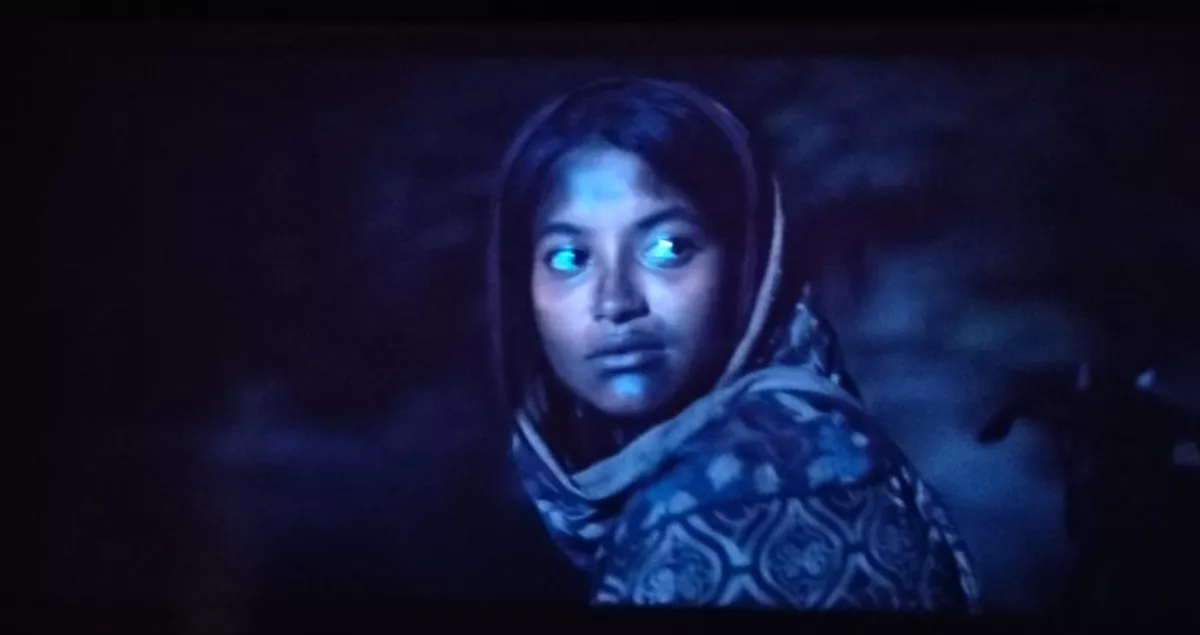
"Roid" is a thought-provoking film filled with metaphors. These metaphors are drawn from different mythological ideas—mythologies that are rooted in old systems of gender roles and power relations between men and women.
Are women stronger or more independent than men? Do women need men to survive? What if Yashodha rejected Gautam Buddha, and she herself became the Buddha? Would the world accept such a reversal, or would it reject and judge it?
When a man leaves a woman and blames her, she often returns—sometimes once or twice, sometimes more than ten times. But when a man repeatedly abandons a woman, and she finally chooses not to return anymore, when she chooses herself, does society truly understand that decision?
Women do not need to be glorified as goddesses or seen as superhuman compared to men. How many times must women say this: treat me as human, treat me as I am, accept me as I am—beyond all social rules and expectations?
When a man breaks a woman’s heart, and she decides not to come back, she simply pushes the boat of life forward and lets him go. She silently tells him, “This is over. If I leave now, I am not coming back this time.” Does the man understand this?
“What’s in a name?” When Shakespeare, a man, said this, the world celebrated him. But in this patriarchal society, a woman has to declare her name repeatedly, because people do not know her identity. She is often known as someone’s daughter or someone’s wife, rather than being recognized as herself.
Even in Christian marriage, they say, “I pronounce you husband and wife.” The word husband comes from Old Norse hūsbōndi, where hūs means house and bōndi means dweller. As a verb, husband also means to conserve resources and use them frugally. And what about animal husbandry? Animal husbandry is a branch of agriculture focused on the breeding, care, and management of livestock and domesticated animals. Its primary goal is to raise animals for human use—meat, milk, eggs, wool, leather. Is the word “husband” related to husbandry?
When a cow gives birth to a calf, or a goat gives birth to a kid, does anybody ask who the father is? But when it comes to women, despite all the care for her health, the man starts questioning who the father is. Sadu needed this answer because it was important to him. It was killing him inside that his wife might not be pregnant by him.
But does Sadu really love that woman? He does not even know how to make love to her. He was just grabbing her, forcing himself on her. After a long time, he gave her soap to wash herself—not for her, but for him.
Roid is a visually rich film with beautiful color grading, cinematography, and strong use of metaphor. In the end, Sadu cooks spicy mutton while his wife used to prepare taler pitha, which represents love, affection, and home. Sadu eats the mutton greedily, almost like a demon, and his body eventually rejects it. He dies while experiencing hallucinations.
What did it mean when all the taal fruits were dropped from the tree? Perhaps it symbolizes how many times Sadu’s wife wanted to return, wanted love and connection, but ultimately chose not to come back.
I know many people have different opinions about this film, different intellectual metaphorical theories based on mythology, and the idea of women as supernatural power or goddess. I don’t really care about all this intellectual benchmarking discussion. It suffocates me as an audience—as a feminist movie-loving audience.
Why can’t they see women as human? Why they need to portray independent women as “Maya”, “Snake” “Ghost” ,“Pagli” “Churail” “Daini” “Pishachini”
Nobody even asked why Sadu was not getting married. Even Sadu himself did not feel like getting married for a long time. He does not know how to love. He was doing “husbandry” of a human being, just like he takes care of his owner’s cows. The owner thinks exactly like my house owner thinks. My house owner recruited a caretaker and preferred a married couple, because if the caretaker is busy, his wife can at least open the gate or look after who is coming and going, free labor.
Human doing husbandry of another human—we all do this. We are all suppressed and buried under society’s capitalist expectations. We are dying like Sadu.
In this movie, Mostafizur Noor Imran did his career-best performance, and Nazifa Tushi, I would say, is one of the best actors of this time. They did unimaginable hard work to make us believe they are those characters.
Is this a piece of art? I don’t know. I don’t fully understand art. I don’t feel the need to overanalyze metaphors. I am just an ordinary audience.

About the Author
Proma Israt
মজদুরের নিয়মিত লেখকWriter, Lawyer and Human Rights Activist
I write to understand life a little better and to give shape to the things we often feel but don’t always say out loud. I have written and published two feminist storybooks that explore gender, social norms, and the everyday experiences of women. For me, writing is a way of connecting—listening to people, noticing small truths, and turning them into words that feel real and human. I believe deeply in humanity and human rights. I stand against all forms of discrimination—whether based on class, social status, economy, or gender. Every person deserves dignity, respect, and equal value.
প্রোফাইল দেখুন

মতামত
এখনও কোনো মতামত নেই।
প্রথম মতামতটি আপনিই দিন।
আলোচনায় অংশ নিতে লগ ইন করুন অথবা এ্যাকাউন্ট খুলুন