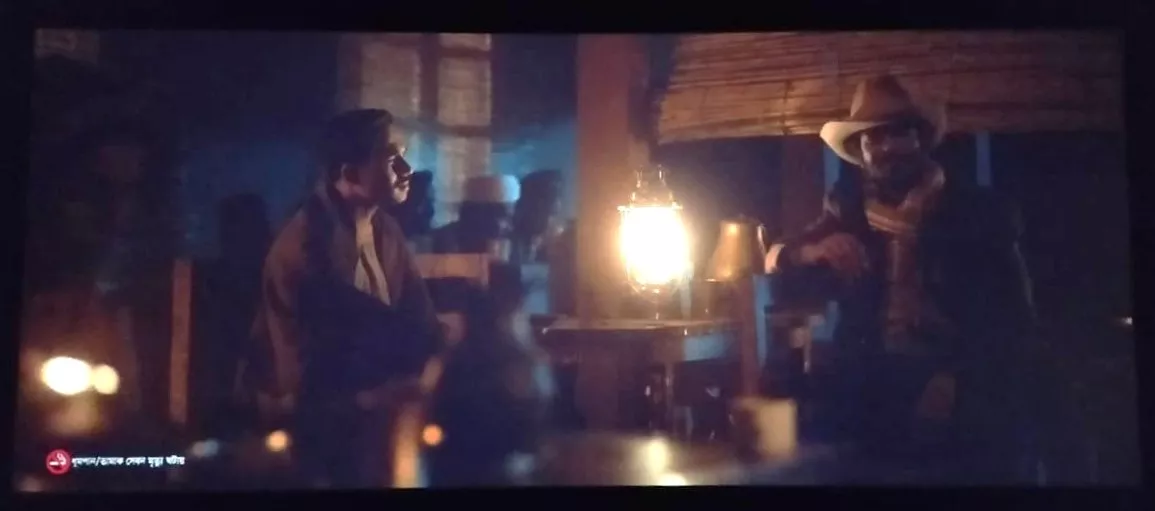
Today, on a gloomy, windy, rainy Sunday, I chose to spend my evening with Bonolota Sen by Masud Hasan Ujjal. The movie was definitely interesting because it was deeply connected with Jibanananda Das's popular and beautiful poem Bonolota Sen. The director tried to portray the poetic journey through a few dreamy, surrealistic sequences.
Honestly, I was bored during the first half. I tried, but failed to connect myself with the film, the actors, or the dialogues. I kept wondering about the man playing "Mohin." Why was he exploiting his housemaid? And why would a PhD student and university teacher have physical intimacy with a man who barely takes showers, starts his day with alcohol like Kabir Singh, and wears the same underwear—nobody even knows whether it was ever washed after he bought it? The man is polygamous, having sex with his housemaid and then with another woman. Are they using protection? What exactly is the director trying to prove? That to find Bonolota Sen, you need to sleep around nonstop with multiple women?
And what about consent and exploitation? The man was having sex in exchange for a valuable original book, and the PhD student agreed to that. He kind of jumped onto the woman without asking for her consent. The director could have made the character a little bolder by letting her clearly say, "Yes, I will have sex with you if that is the condition for getting this book." Instead, she stood there like a hypnotized woman. Nobody could tell whether it was consensual or not.
Through this imperfect script, the director also showed the time dimension—or perhaps I should say the dream dimension—of Jibanananda Das, who was attracted to a schoolgirl. I mean, what is this? Are you living inside the novel Lolita? In old Indian culture, or in many cultures, we have seen practices such as incest, pedophilia, and many other things that are now illegal and strongly prohibited. Human beings, as animals, are naturally polygamous, and many things happened throughout history that we can or cannot even imagine today. Jibanananda Das was involved with his cousin, which was prohibited even during his time.
Jibanananda Das was jobless and still married the highly educated Labonya Das. Labonya Das, in this film—or perhaps from Jibanananda's point of view—was Medusa, who made his life so miserable that he wanted to commit suicide. Yes, as a feminist, I can easily say that he was also a victim of patriarchal society—a society where a man is expected to be the main provider. He has to get married, earn money, and become more successful than his parents—not just a little successful, but successful enough to provide for his family.
On the other hand, the director honestly showed the difference between the lives of male and female poets. The male poet, Jibanananda, was simply sitting at a table with his diary, pen, and papers, writing peacefully—or thinking about whatever he wanted. Meanwhile, his mother, Kusumkumari Das, was writing poetry while cooking, cutting vegetables, putting them into the pot, sitting in front of the stove. That scene hit me hard. It immediately reminded me of Virginia Woolf and A Room of One's Own.
The surrealistic character MOHIN was exploring life. He was not earning money; he was searching for Bonolota Sen. A man is allowed to exist even if he is unemployed, polygamous, or does not take showers for months. But if a woman tries to explore life in the same way, society will eventually find her in a brothel as a prostitute, or slut shame her.
The character Mohin blamed Rabindranath and his elite circle for criticizing Jibanananda Das, even suggesting that they were responsible for plotting his suicide. Jibanananda only needed a little acceptance, recognition, and praise from this elite literary circle, but he never received it. He was a GRAMER GORIB KOBI, a loser in Labonya's eyes, a disappointment to his children, an unsuccessful, "unmanly" figure who simply wanted to leave this earth.
Jibanananda's parents were somewhat progressive—progressive enough to allow their daughter-in-law to sing on her wedding night—but not progressive enough for their son to tell his mother, "I don't want to get married because I don't have a job, and I don't love Labonya." Jibanananda's greatest failure, perhaps, was that he was a poor communicator.
I don't know why journalists nowadays focus so much on the bold scenes while writing about any film, but the scene where Jibanananda was masturbating because Labonya refused to sleep with him completely broke my heart. Because physical intimacy is not just about satisfying sexual urges. It is about peace, shelter, safety, recognition, a soul-to-soul connection, and unconditional love and affection beyond material responsibilities. The poet tried to write about those forty-eight minutes of peace, shelter, and physical love in his poem Bonolota Sen. Perhaps he never truly received them from any woman.
I liked a few scenes from the film. The cinematography was lovely. However, I disagreed with many of the director's creative choices. I will not say he succeeded in every scene, but a few of them were absolutely amazing. He genuinely tried to break down the poem Bonolota Sen, and I appreciate that effort.
I really loved Khairul Basar's voice and the amount of hard work he put into doing justice to his character. I appreciate all the female actors—they looked beautiful on screen—but while delivering their dialogues and performances, I felt they were overshadowed by Khairul Bashar and Shohel Mondol. That said, Nabila performed well in the second half of the movie, and I especially loved Naziba Bashar's work.
Shohel Mondol, one of my favorite actors, worked incredibly hard on this project. I could genuinely feel that he treated it as his own craft.
I honestly do not care much about the so-called bold scenes people keep talking about. The real bold decision was making this kind of film and working so hard to do justice to it, because you simply cannot make enough money from films like this.
I appreciated the director's effort to portray prostitution, imperialistic colonial exploitation, the history of women's resistance, women revolutionaries, broken dreams, and the struggles of women. The film reminds us that if a woman wants to fulfill her dreams, she has to work twice as hard. She has to become a mother, a homemaker, and only then can she write poetry while sitting in front of a stove.
Jibanananda Das was a poet. We all have to agree that he seemed to write his poems from another world—as if they were falling from heaven, or perhaps from somewhere between heaven and hell. His choice of words, his poetic depression, his broken heart, and his frustrations felt as though they were written with the ink of moonlight, the tears of clouds, and the blood of the setting sun.
What else can I say about this film?
I am just an ordinary audience.

About the Author
Proma Israt
মজদুরের নিয়মিত লেখকWriter, Lawyer and Human Rights Activist
I write to understand life a little better and to give shape to the things we often feel but don’t always say out loud. I have written and published two feminist storybooks that explore gender, social norms, and the everyday experiences of women. For me, writing is a way of connecting—listening to people, noticing small truths, and turning them into words that feel real and human. I believe deeply in humanity and human rights. I stand against all forms of discrimination—whether based on class, social status, economy, or gender. Every person deserves dignity, respect, and equal value.
প্রোফাইল দেখুন
মতামত
এখনও কোনো মতামত নেই।
প্রথম মতামতটি আপনিই দিন।
আলোচনায় অংশ নিতে লগ ইন করুন অথবা এ্যাকাউন্ট খুলুন