
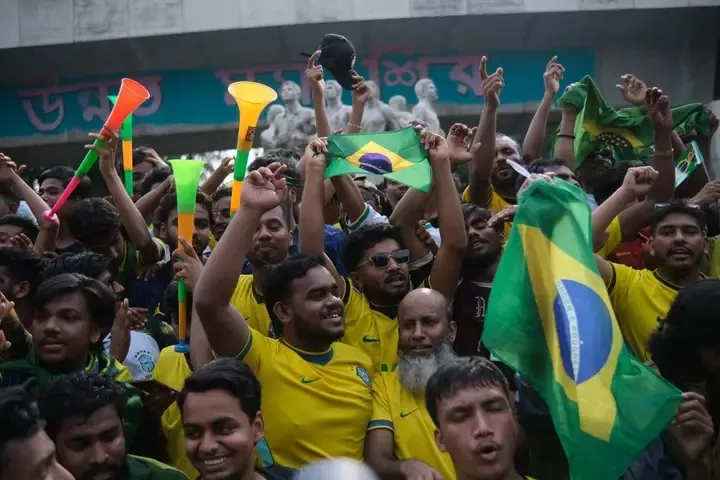
When a Brazil–Argentina match approaches in Bangladesh, I notice something that moves me deeply that people gather in ways increasingly rare today.Like men and women, young and old, neighbours and strangers sit side by side, arguing, joking, sharing food, and collectively inhabiting the same emotional space. In an era defined by digital technologies, algorithmic feeds, and personalised consumption, where human connections seem to be eroding and people appear less like "subjects", engaged in shared social worlds than isolated individuals interacting through screens, this spectacle of togetherness feels significant to me.I was thinkjng that could this powerful affective energy,this capacity for spontaneous collectivism be understood as more than mere football fandom, perhaps even as the basis for a different kind of solidarity capable of resisting the fragmentation produced by contemporary digital capitalism?
I can not take this arbitrarily.Ask that,why Brazil and Argentina rather than, say, England or Germany?Or italy-spain?Probably in the shared structure of peripheral position within the global order. England and Germany are European, wealthy, historically dominant. Brazil and Argentina are Latin American, have histories of colonial domination (by Portugal and Spain respectively), are integrated into the global economy in subordinate positions, and have populations that include significant African and indigenous descent. The identification,i can not say that it is arbitrary but its structured by a homology of position, a recognition, perhaps only semi-conscious, that these societies share a structural location in the world-system. The capitalist world-system is organised into core, semi-periphery, and periphery(wallerstein).
Core nations is like, the United States, Western Europe, Japan extract value from the periphery through unequal exchange, debt, structural adjustment, and the global division of labour. Bangladesh, Brazil, and Argentina all occupy positions below the core, though at different levels of the hierarchy. This shared structural position is the material foundation for the cultural identification Bangladeshi fandom represents i think.
But i want to be a bit ambitious here.lol. Since the 1970s, Bangladeshi football fandom has been strongly shaped by identification with figures like Pelé and Diego Maradona, later evolving through Lionel Messi and Cristiano Ronaldo into a distinctive culture of Brazil–Argentina rivalry that often appears detached from Bangladesh's own national context. Yet Bangladesh, Brazil, and Argentina share histories of colonial domination and continuing integration into an unequal global capitalist order. While Latin American football has traditionally been associated with creativity, improvisation, and popular expression, contemporary football discourse increasingly privileges European tactical efficiency, and the global football economy remains heavily centred on European clubs that absorb much of Latin America's talent and financial value.
Against this backdrop, could Bangladeshi support for Brazil and Argentina be interpreted not merely as entertainment or celebrity attachment, but as a form of postcolonial identification and symbolic solidarity with societies that have experienced similar histories of dependency and subordination? And is it possible to imagine the intense Brazil–Argentina rivalry in Bangladesh being rearticulated into a broader anti-imperialist consciousness directed at the structural inequalities of global capitalism and the Eurocentrism of contemporary football? can transnational sports fandom function as an expression of political resistance and under what social, cultural, and ideological conditions might football loyalties be transformed from horizontal rivalries between subaltern populations into a shared critique of the global hierarchies that shape both the world economy and the modern game?
I think It's time to think about this.


মতামত
এখনও কোনো মতামত নেই।
প্রথম মতামতটি আপনিই দিন।
আলোচনায় অংশ নিতে লগ ইন করুন অথবা এ্যাকাউন্ট খুলুন