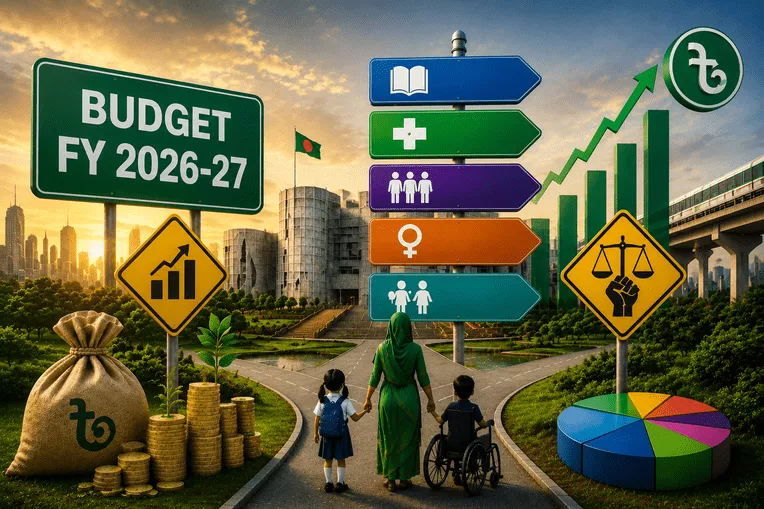
Bangladesh’s FY2026-27 national budget wants to be read through the lens of size. According to the official FY2026-27 Budget Speech, the proposed outlay is Tk 9,38,000 crore. Development expenditure is set at Tk 3,16,075 crore, including a Tk 3,00,000 crore Annual Development Programme. According to Bangladesh Pratidin, the proposed national budget for FY2026-27 allocates Taka 3 lakh crore for the Annual Development Programme to support inclusive economic growth, infrastructure, social protection, and climate-resilient initiatives. For women and children, these are not abstract sectors. They shape whether a girl remains in school, whether a pregnant woman reaches care, whether a child receives food support, whether a child with disability gets services, and whether a poor household survives a shock without falling deeper into distress.
But size is not the same as clarity. A development budget becomes meaningful for women and children only when it shows who is being reached, where support is going, when money is released, and what changes in people’s lives are resulting. According to The Business Standard, the proposed FY2026-27 budget includes a Tk5,196 crore allocation for the Ministry of Women and Children Affairs, with funds directed toward women and children development programs, the establishment of 20 new daycare centres, and food support for over one million women, but it remains unclear how comprehensively the budget addresses the specific needs of women and children.
The ADP grows, but the beneficiary remains blurred.
The strongest development signal is the ADP’s human resource allocation. This category receives Tk 1,28,426 crore, equal to 42.8% of the total ADP. Within it, the Ministry of Primary and Mass Education receives Tk 21,441 crore, the Health Services Division receives Tk 26,806 crore, and the Secondary and Higher Education Division receives Tk 20,835 crore.
These are the right places to look. Primary education is directly connected to children. Health services are central to pregnant women, newborns, and adolescent girls, as well as immunisation and nutrition. Secondary education affects girls’ retention, skills and protection from early marriage.
The problem is not sectoral relevance. The problem is traceability. The budget does not show, in clear programme-level terms, how much of this expanded ADP will directly reach girls, children under five, children with disabilities, adolescent mothers, malnourished children, children outside school, street-connected children, or women and children in remote, poor and climate-vulnerable communities.
A general education or health allocation may serve. That is not the same as a targeted investment in women's and children’s development. To make that claim credible, the budget must show targeted allocation, beneficiary data, delivery timeline and outcome indicators. Without those, women and children remain visible in language but indistinct in accounting.
The direct ministry is still too small for the mandate.
The Ministry of Women and Children Affairs is the clearest institutional marker of direct fiscal commitment to women and children. According to thefinancetoday.net, the Cabinet has approved the proposed national budget for FY2026-27 at a special meeting chaired by Prime Minister Tarique Rahman.
This matters because MoWCA’s mandate is broad: women’s empowerment, childcare, violence prevention, vulnerable children, working women’s support, rehabilitation and coordination across women and child development initiatives. A ministry with such a mandate cannot remain fiscally marginal if the budget’s claim to human development is to be taken seriously.
All women- and child-related spending should not be expected to pass through a single ministry. Education, health, social welfare, disaster management and local government are also crucial. The issue is coordination. When spending is spread across ministries without a clear tracking system, responsibility becomes diffuse. Women and children can be named across the budget yet remain hard to track in terms of allocation, release, expenditure, and outcomes.
This weakness is sharper for children. Bangladesh has built a gender-responsive budgeting structure, but it still lacks a regular, government-owned child-focused budget framework comparable to it. According to the Social Security Budget Report 2025-26, child-focused spending in Bangladesh is spread across sectors such as education, health, nutrition, social protection, child protection, disability support, and local services, making it difficult to determine exactly how much development funding is directed toward children and which groups of children benefit.
Policy promises need budget visibility.
The budget includes several commitments that matter for women and children. In education, this refers to free education for girls up to the graduate level; support for poor students through uniforms, shoes, and school bags; inclusive education for children with disabilities; assistive technology; educational materials; and a Mid-Day Meal Programme. These measures address real barriers to attendance, retention, learning and nutrition.
But a commitment becomes credible only when it is budget-visible. Which schools will receive meals first? Which students will qualify for material support? How will disability inclusion be financed beyond equipment? Will poor and remote schools receive funds on time? Will attendance, dropout and learning outcomes be tracked by sex, disability and location?
The education allocation has increased to 2% of GDP, up from 1.39% in FY2025-26. Even so, it remains below UNESCO’s 4%-6% of GDP benchmark for education financing. That gap does not make the new allocation meaningless. It simply means Bangladesh should not treat a one-year increase as the completion of its education commitment.
Health presents a similar picture. The Ministry of Health and Family Welfare receives Tk 69,409 crore, equal to 1.02% of GDP, compared with Tk 35,477 crore or 0.58% of GDP in the revised FY2025-26 budget. The budget also addresses maternal and child health, nutrition support, community-level care, upazila-level maternal, neonatal, child, and reproductive health services, and the recruitment of 100,000 health workers, of whom around 80% are expected to be female.
These are important directions. Their impact will depend on placement and delivery. Will new health workers be posted where women and children face the largest access gaps? Will maternal and child health receive facility-level financing? Will adolescent health, newborn care, nutrition and immunisation be tracked separately? A higher health allocation can still miss vulnerable women and children if staffing, medicine supply, referral systems and local monitoring are lacking. Social protection also contains a promising but incomplete signal. The Family Card Programme proposes distributing cards to 4.1 million women, allocating Tk 14,500 crore. According to a report from tbsnews.net, the FY2026-27 programme design includes providing direct support to women by allocating funds specifically for women's and children's development, acknowledging women as primary recipients rather than dependents within households.
The Mother and Child Assistance Programme is more directly linked to women and children. According to The Daily Star, the proposed national budget for the fiscal year 2026-27 was approved at a special cabinet meeting chaired by Prime Minister Tarique Rahman. The unchanged allowance is the concern. In an inflationary economy, a transfer can expand in terms of headcount while losing real purchasing power.
Implementation is the real credibility test.
The main risk of the FY2026-27 development budget is not the absence of commitments, but whether it can be effectively implemented on time. Historical evidence shows execution challenges: in FY2025-26, ADP implementation reached only 40.7% by March, highlighting the risk that even a larger budget may not translate into timely service delivery.
Implementation delays directly affect women and children. A late stipend may fail to prevent school dropout; delayed nutrition transfers can miss critical windows during pregnancy; postponed school meals cannot address hunger at the right time. Health projects delayed due to procurement cannot protect newborns during outbreaks, and child protection services without timely staff and operational funding cannot respond to abuse or neglect. Timing is an integral part of social development: money spent late often fails to produce the intended impact.
For this reason, the FY2026-27 budget should not be judged solely by what is announced in June. It must be evaluated across the full chain: original allocation, revised allocation, fund release, actual expenditure, beneficiary reach, and outcome. Only through this lens can the state’s commitment be verified.
The FY2026-27 budget contains several openings worth acknowledging. Development expenditure has expanded, and the human resources sector receives a significant share of ADP. Education commitments include support for girls, poor students, children with disabilities, and school meal programmes. Health allocations target maternal and child services, community-level care, and recruitment of 100,000 health workers, approximately 80% of whom are female. Social protection recognises women through the Family Card Programme, and Mother-and-Child Assistance coverage is proposed to rise.
These signals are positive, but they are not yet proof of a women and child-responsive development budget. The missing link is traceability: the budget must show which programmes are designed for women and children, the exact amounts allocated, where they operate, who benefits, when services are delivered, and whether outcomes improve. Programme-level allocations, original and revised budgets, actual expenditures, and beneficiary data by sex, age, disability, and district must be transparent. A clear, child-focused budget framework is also essential so that children are not hidden within broad household, education, or health categories.
Bangladesh does not need a development budget that merely mentions women and children. It needs one that can follow public money to the people whose lives it is meant to improve. The real test of FY2026-27 is not the size of the ledger, but whether a girl in school, a pregnant mother at a clinic, a child with disability, a street-connected child, or a climate-vulnerable household actually experiences the benefits of the budget.
About the Author
Md. Shahidul Alam
মজদুরের নিয়মিত লেখকResearch and Development Professional
Researcher and writer exploring climate change, displacement & refugee issues, labour, social stigma, and social transformation in Bangladesh through ethnographic and community-based research. Interested in Anthropology, development, memory, and the politics of everyday life.
প্রোফাইল দেখুন
মতামত
এখনও কোনো মতামত নেই।
প্রথম মতামতটি আপনিই দিন।
আলোচনায় অংশ নিতে লগ ইন করুন অথবা এ্যাকাউন্ট খুলুন