
Bangladesh knows what to do with an empowered schoolgirl. We can put books in her hands, give her a scholarship and turn her into a symbol of national progress.
We are less comfortable with what happens when that girl grows up.
Can she become the family’s principal earner? Can she prioritise a career without being considered selfish? Can she lead men at work, postpone marriage, refuse dowry disguised as “gifts,” or expect her husband to cook dinner? Can she become something more than an educated version of the wife and mother society had already chosen for her?
This is where Bangladesh’s celebrated story of women’s empowerment begins to unravel. We pushed girls into classrooms, but did not prepare families, workplaces or institutions to accept them as equals. We changed women’s qualifications without changing the terms on which they are allowed to use them.
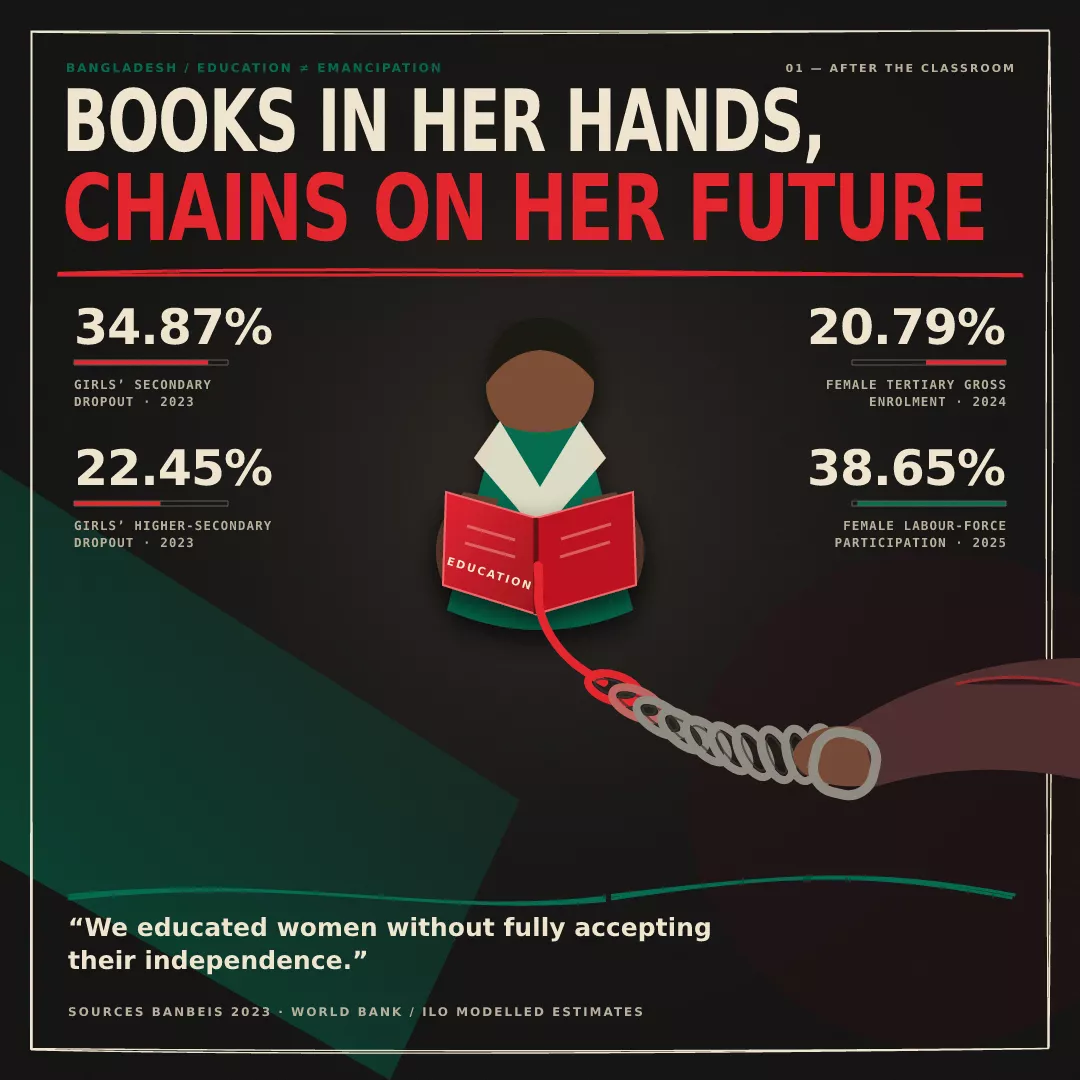
The educational gains are real, but so is the narrowing that follows. In 2023, BANBEIS recorded a dropout rate of 34.87 percent among girls in secondary education and 22.45 percent in higher-secondary grades 11 and 12. Female tertiary gross enrolment stood at 20.79 percent in 2024. These figures measure different stages and should not be turned into a single mathematical pipeline. But they show how quickly the promise of universal schooling becomes more selective as girls approach adulthood.
The labour market narrows the field further. In 2025, only 38.65 percent of Bangladeshi women aged 15 and above were participating in the labour force, while 37.23 percent were employed. That means nearly two-thirds of adult women were outside paid work altogether.
The official unemployment rate for women was only 3.67 percent, but this is less reassuring than it appears. Unemployment is measured only among women who are working or actively seeking work. A woman who has stopped searching because her family will not let her work, because she cannot travel safely, because childcare is unavailable, or because every available job conflicts with her domestic responsibilities disappears from the unemployment figure. She is no longer counted as unemployed. She is simply counted out.
This is the sleight of hand at the centre of our empowerment story. We celebrate the woman who reaches the classroom or factory floor, but pay less attention to the forces that keep millions of others at home, push them out after marriage, or confine them to positions with little authority.
The ready-made garments industry is often presented as the strongest evidence that paid work has transformed Bangladeshi women’s lives. There is truth in that claim. Factory employment brought income to women who had few other opportunities. It gave many a greater voice within their families and helped shift public attitudes about women working outside the home.
But we should be honest about the kind of empowerment the industry has offered.
Women have been welcomed most readily where their labour is cheap, repetitive and replaceable. They fill production lines while remaining far less visible in supervision, management, technical work and ownership. The industry can accept a woman sewing garments for export more easily than it can imagine her directing operations, negotiating with buyers or sitting in the boardroom.
This is not equality. It is an economy finding a profitable use for women without surrendering much power to them.
Automation makes the contradiction harder to ignore. The repetitive production roles in which women are concentrated are also among those most exposed to technological change. If women are not given access to technical training, management pathways and transferable skills, the sector celebrated for bringing them into paid work may leave many behind as production changes.
A job is not empowering merely because a woman performs it. Empowerment depends on whether the job gives her security, bargaining power, mobility and the ability to leave. Work that keeps women poorly paid, easily replaceable and permanently below management may generate income without producing equality.
The same contradiction exists inside the home.
Bangladesh produced generations of children who watched Meena challenge discrimination, attend school and demand fair treatment. Yet our public imagination seems to stop at school-age Meena. We rarely imagine the adult version: Meena as an executive, factory manager, engineer, political leader or entrepreneur whose husband takes responsibility for half the housework.
The difficulty is not imagining women at work. It is imagining men changing because women work.
An educated man may support women’s employment in principle and still expect his wife to cook, clean, care for children, look after elderly relatives and manage the emotional life of the household. He may praise successful professional women while wanting a wife whose career never inconveniences his own. He may call himself progressive because he “allows” her to work, without questioning why her employment requires his permission.
The language changes. The hierarchy survives.
Working women therefore perform two shifts. One is recognised, scheduled and sometimes paid. The other begins when they return home. Their male colleagues may use the evening to rest, study, network or prepare for the next promotion. Women use it to cook dinner, supervise homework, clean the house and care for relatives. When they fall behind professionally, the result is treated as a difference in merit rather than a difference in available time.
Marriage often intensifies this pressure. A woman’s career is treated as supplementary even when her earnings are essential. If the household becomes difficult to manage, her job is the first one considered negotiable. If a child needs care, she is expected to step back. If her husband receives an opportunity elsewhere, her work is expected to move—or disappear—with him.
Then society points to women leaving employment as though they freely chose domestic life over professional ambition.
The same double standard shapes public discussion of divorce. Educated women are sometimes accused of becoming too independent, too demanding or unwilling to compromise. The possibility that education gives women the confidence to reject abuse or intolerable inequality receives less attention.
Consider what the supposedly “spoiled” educated woman is expected to do. She must work as seriously as a man but treat her career as less important. She must contribute income without becoming too independent. She must remain agreeable, preserve the marriage, absorb exhaustion and avoid challenging her husband’s authority. If the arrangement collapses, her education becomes the suspect rather than the impossible arrangement itself.
Domestic violence remains protected by similar expectations. Reporting abuse can be treated as an admission that a woman failed to preserve her marriage. Families may worry more about reputation than safety. Patience is prescribed to the victim; change is rarely demanded of the abuser.
Dowry, too, survives through adaptation. It is increasingly presented as voluntary gifts, assistance or customary generosity. But a gift shaped by expectation, competition and fear of social humiliation is not entirely voluntary. The terminology becomes more respectable while the burden remains with the bride’s family.
This is how patriarchy survives modernisation. It does not always prohibit women from studying or working. It allows them to progress, but only within boundaries that preserve the old distribution of power.
Bangladesh has tried to balance women’s empowerment with “cultural sensitivity.” In practice, cultural sensitivity has often meant asking women to advance without making men, families or institutions uncomfortable. Women may study, as long as education does not challenge marriage. They may earn, as long as income does not produce autonomy. They may work, as long as men are not expected to assume an equal share of domestic life. They may succeed, as long as they remain in supporting roles.
That is not a balance. It is a gridlock.
Nor can Bangladesh assume that time will solve it. Social attitudes do not automatically become more equal with economic growth or higher education. Educated people can carry the same prejudices in more polished language. Conservative movements are gaining strength in many parts of the world, showing that rights can retreat as well as advance.
Gender education must therefore reach beyond girls. Boys must learn that domestic work and care are not female obligations. Universities must address harassment and discriminatory expectations, not merely increase female enrolment. Employers must create credible pathways from entry-level work to technical and managerial positions. The state must invest in childcare, safe transport and labour protection so that employment does not depend on a woman’s ability to absorb impossible pressures privately.
Popular culture also matters. Bangladesh needs images of adult women exercising authority without being portrayed as unnatural, lonely or morally suspect. A female manager should be ordinary. A working mother should not have to perform guilt. A father preparing dinner while his wife works late should not be presented as comic, heroic or emasculated.
Shared responsibility must become standard, not revolutionary.
Bangladesh’s women’s empowerment looks impressive when measured through enrolment, examination results and the number of women entering selected industries. But these achievements can conceal a deeper continuity. We have educated women without fully accepting their independence. We have recruited their labour without sharing power. We have expanded their responsibilities without reducing the responsibilities already assigned to them.
We did not dismantle the old system. We modernised it.
The next stage of women’s progress will not be achieved by sending girls to school and congratulating ourselves. It will begin when the educated girl can become an independent adult without being punished for it—when she can lead, earn, decide and expect equality at home as well as at work.
Until then, the image of progress will remain more convincing than the progress itself.
Sources
[1] BANBEIS, Bangladesh Education Statistics 2023: objectstorage.ap-dcc-gazipur-1.oraclecloud15.com/n/axvjbnqprylg/b/V2Ministry/o/office-banbeis/2024/12/18eb15a7026f431394e022af7e36a03a.pdf [2] World Bank, female tertiary gross enrolment: api.worldbank.org/v2/country/BGD/indicator/SE.TER.ENRR.FE?format=json&source=2&per_page=100
[3] World Bank/ILO, female labour-force participation: api.worldbank.org/v2/country/BGD/indicator/SL.TLF.CACT.FE.ZS?format=json&per_page=100
[4] World Bank/ILO, female employment-to-population ratio: api.worldbank.org/v2/country/BGD/indicator/SL.EMP.TOTL.SP.FE.ZS?format=json&per_page=100
[5] World Bank/ILO, female unemployment: api.worldbank.org/v2/country/BGD/indicator/SL.UEM.TOTL.FE.ZS?format=json&per_page=100

মতামত
এখনও কোনো মতামত নেই।
প্রথম মতামতটি আপনিই দিন।
আলোচনায় অংশ নিতে লগ ইন করুন অথবা এ্যাকাউন্ট খুলুন