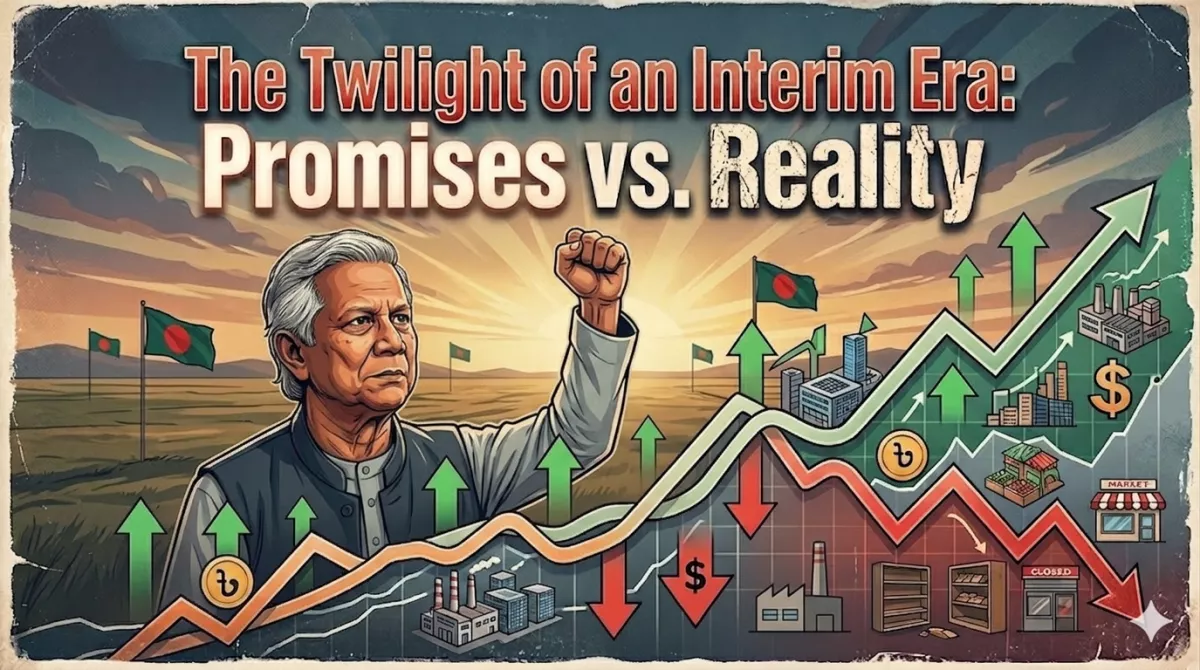
An era has come to an end with the departure of what was arguably post-independence Bangladesh’s most talked-about interim government—an administration that stood at the rare intersection of overwhelming public backing and relentless controversy. Rising from the collapse of a 17-year Awami League regime, the Dr. Yunus-led administration took office amidst a wave of popular uprising, carrying the heavy mantle of reform and good governance. The expectations of the masses were clear: stability, freedom of speech, unwavering human rights, and the birth of an egalitarian society. However, as the 17-month tenure draws to a close, a critical question looms—how successful has this government truly been in fulfilling its pledge to the nation?
The most pressing litmus test for this administration was the restoration of law and order. Upon assuming power, its primary mandate was to transition the state away from an era of enforced disappearances, extrajudicial killings, and the systematic suppression of dissent, toward a secure and stable environment. It is worth noting that between 2021 and August 5, 2024, the country witnessed a disturbing cycle of extrajudicial killings and political violence, which eventually led to US visa sanctions on high-ranking law enforcement officials.
Data from various human rights organizations, however, presents a sobering reality. According to HRSS, 33 individuals fell victim to 31 incidents of extrajudicial killings in 2023. Ain o Salish Kendra (ASK) reports that in 2025, that number stood at 32. Since taking charge on August 8, 2024, at least 12 people were killed in the first four months of this administration. In total, over the 17-month tenure of the interim government, approximately 45 individuals have reportedly lost their lives to extrajudicial or custodial killings.
These figures are corroborated by the human rights organization ‘Odhikar,’ which reports 40 extrajudicial killings in the first 14 months of the interim government's rule. Of these, 19 were shot dead, 14 died under torture, and 7 were beaten to death—with allegations of involvement frequently leveled against the police and joint forces.
Furthermore, deaths in prison custody have seen a troubling rise. ASK records indicate that 95 individuals died in custody up to November 2025, compared to 65 in 2024, 106 in 2023, and 65 in 2022. The surge in the recovery of unidentified bodies further underscores the fragility of the current security landscape. According to the Manabadhikar Sanskriti Foundation (MSF), the number of unidentified bodies rose from 352 in 2023 to 504 in 2024, and reached a staggering 586 by November 2025.
Mob Violence: The Darkest Stain on the Interim Tenure
Undoubtedly, the most condemned and abhorrent phenomenon under this interim government has been the rise of mob violence. Far from taking significant preventive measures, the administration failed to provide even the bare minimum of deterrence. Among the countless disgraceful incidents of these 17 months, we have witnessed horrors such as exhuming bodies from graves to set them ablaze, hanging individuals from trees to be burned, or continuing to burn victims until their deaths were certain.
Furthermore, lynchings fueled by allegations of religious defamation have become tragically "commonplace." Atrocities such as stoning in broad daylight or the brutal, repeated beating of an individual to death within a university campus—after mockingly feeding them rice—reflect a level of savagery that perhaps surpasses the Dark Ages or the era of Jahiliyyah. These are the grim realities we have observed during the 17-month period some are now calling the ‘Ayyam-e-Nobelia’ (The Era of the Nobelist).
The statistics are staggering. In 2023, 51 people were killed in mob lynchings. However, according to the Manabadhikar Sanskriti Foundation (MSF), that number surged to 146 in 2024, with 98 of those deaths occurring in the five months following August. The Ain o Salish Kendra (ASK) further reports that between January and November 2025, 184 people lost their lives to mob violence—the highest recorded in any comparable period. In total, human rights organizations estimate that 293 people have been lynched during this government's tenure. For context, ASK records show 28 such deaths in 2021, 36 in 2022, 51 in 2023, and 128 in 2024.
Data compiled by Prothom Alo regarding 67 deaths in 46 lynching incidents between August 2024 and September 2025 reveals a disturbing culture of impunity: the arrest rate remains negligible. In many instances, no cases were even filed; where they were, suspects often remained at large. Of the 46 incidents, legal action was initiated in only 36 cases, while 10 went entirely unrecorded.
The catalog of vandalism, looting, and arson is so extensive that documenting it fully would require the dedicated efforts of historians. Among the most searing examples are the targeted attacks on major media outlets like Prothom Alo and The Daily Star, as well as cultural institutions such as Chhayanaut and Udichi.
Public safety has deteriorated across other fronts as well. Between January and November 2025, 1,110 kidnapping cases were registered, nearly doubling the 642 cases recorded in all of 2024. Police Headquarters data confirms that 3,509 murders took place up to November 2025. Crimes such as theft, robbery, and mugging have spiked, with total cases rising by approximately 16.5% annually. Serious offenses, including assault and kidnapping, are increasingly prevalent, leaving citizens feeling profoundly insecure in public spaces and at night. As noted in a Freedom House report, even after the transition of power following long-standing dominance, grave questions remain regarding the fundamental state of civil liberties and freedom.
The Assault on Pluralism and Cultural Identity
The targeted harassment of marginalized groups, minorities, and women—alongside attacks on Sufi shrines (mazars) and folk singers (Bauls)—has reached an unprecedented level of intensity. The systematic obstruction of traditional fairs, religious festivals (Urs), theatrical plays, and film screenings marks a sharp departure from the country’s pluralistic past. More concerning than the incidents themselves has been the interim government’s palpable lack of resolve in curbing these forces. On the contrary, statements from some high-ranking officials have been widely criticized for providing tacit support to these regressive elements.
Religious and ethnic persecution remains a persistent reality. According to the Bangladesh Hindu Buddhist Christian Unity Council, 2,673 incidents of persecution occurred between August 4, 2024, and November 30, 2025. This grim tally includes 82 murders and 44 cases of rape. While the government officially claimed that only 71 out of 645 incidents in 2025 were "unavoidable" sectarian clashes, dismissing the rest as "ordinary crimes," the reality of thousands of homes, businesses, and temples being vandalized tells a different story—one that has sparked grave international concern.
A radicalized ideological shift has fueled a broader assault on the nation's cultural consciousness. Reliable reports confirm that at least 113 shrines and dargahs across the country were targeted, vandalized, or torched, often with the administration failing to mount any effective defense. This assault on Bengali heritage stands as one of the darkest chapters of the last 17 months. Public artworks and sculptures have been razed nationwide. From Lalon Shah’s shrine to various folk festivals, extremist groups have launched coordinated attacks. The persecution of Bauls and mendicants—ranging from the forced cutting of their hair to arbitrary arrests and physical torture—has become a harrowing recurring theme.
The safety of indigenous communities, particularly in the Chittagong Hill Tracts (CHT), also remains under severe threat. Data from the Kapaeing Foundation reveals that between January and July 2025, there were 24 documented cases of violence against indigenous women, with 21 occurring in the CHT. These include instances of gang rape and murder. Furthermore, 34 human rights violations—ranging from custodial deaths and arbitrary detentions to harassment and forced conversions—have been recorded. Even when these communities staged legitimate protests, they faced hostility not only from extremist factions but also from law enforcement agencies. Meanwhile, mirroring the patterns of previous regimes, state-led oppression of the Bawm community continues unabated.
The Erosion of Rights: From Gender Violence to Media Censorship
The persistent obstruction of women’s football and the public physical harassment of women—often followed by the audacious release of perpetrators after arrest—have become alarmingly normalized. Police crackdowns on anti-rape rallies further provide a state-sanctioned veneer to this culture of impunity. Moreover, the government’s capitulation to extremist demands—replacing music teachers with religious instructors in primary schools—clearly signals a regressive shift in the socio-cultural fabric of Bangladesh. Such incidents stifle the country's progressive and cultural transformation, posing a grave threat to the ideals of a democratic society.
Despite lofty promises of ensuring media freedom, the reality is starkly different. The draconian Cyber Security Act (formerly DSA) remains in force; journalists are being detained for months simply for speaking about independence and the Liberation War on talk shows. Murder and incitement charges have been slapped against hundreds of senior journalists, while even renowned figures like Nurul Kabir have faced systemic harassment.
The Ministry of Information’s revocation of permanent and temporary press accreditation for 167 journalists is nothing short of strangling independent journalism. According to the human rights organization ARTICLE 19, 232 violations of freedom of expression occurred in the first half of 2024 alone. There are reports of an additional 151 incidents involving journalists, activists, and citizens, resulting in the deaths of at least five journalists and 71 physical assaults. Data from Dhaka Courier shows that between August 2024 and July 2025, a total of 496 journalists were targeted through physical attacks, threats, and institutional pressure. This staggering figure highlights a perilous environment for a free press.
The space for dissent has shrunk to a suffocating degree. Expressing a differing opinion or even reacting with a "Haha" emoji on Facebook has led to terminations from banks, hospitals, and government services, followed by brutal killings in some cases. We have seen a father murdered while out to buy milk for his newborn, and another denied parole even for the funeral of his wife and infant. In an unprecedented move, the highest number of lawyers in history were detained from court premises simply for attempting to represent defendants seeking bail.
The humanitarian cost of this political instability is reflected in the ASK report, which states that in 2025, political violence and clashes left 5,604 people injured and 86 dead.
Institutional Decay and Economic Freefall
International observers, including Human Rights Watch and other global bodies, have raised "profound concerns" regarding the human rights situation in Bangladesh, citing a surge in repressive tactics and a pervasive culture of impunity within law enforcement. Under the banner of "Operation Devil Hunt," more than 48,000 raids have been conducted, leading to the arbitrary arrest of countless innocent citizens.
Within the civil administration, the chain of command has effectively collapsed. An unprecedented "OSD" (Officer on Special Duty) culture, coupled with the marginalization of meritorious officials based on political "tagging," has crippled the bureaucracy. For the first time in history, government officials are being transferred via lottery, while blatant nepotism in appointments—spanning from universities to top-tier administrative posts—serves as a stark reminder of the systemic rot and moral decay within this administration.
Furthermore, a massive number of teachers and officials have been summarily dismissed or harassed under the convenient label of being "Swoiracharer Doshor”. In a troubling display of double standards, a female teacher was dismissed for merely asking a student to remove her hijab, an act branded as "Islamophobic" or "religious defamation." Yet, when inflammatory or absurd political rhetoric is used—such as promoting a specific party through "Jannat (?!)” or questioning the dead in their graves about their voting preferences—it is met with absolute silence, devoid of any accountability.
However, the most terrifying picture emerges when we look at the economy. Excluding the pandemic years, Bangladesh’s GDP growth has plummeted to its lowest in 25 years, according to the Bangladesh Bureau of Statistics (BBS). Investment has hit a decade-long low. For three consecutive fiscal years, inflation has hovered around 10%—a crisis unseen since 1986. This sustained high inflation has shattered the cost of living for ordinary citizens. With market syndicates running rampant, economic security has become a myth. Real income has declined as wage growth has lagged behind inflation for 39 consecutive months. Stagnant investment has led to massive job losses, with the closure of numerous factories leaving hundreds of thousands of workers unemployed and driving up the numbers of the poor and extreme poor.
The agricultural sector is also in distress, with growth at a 10-year low, threatening national food security. The banking sector remains fragile, burdened by skyrocketing defaulted loans and a total loss of public and private confidence. The National Board of Revenue’s (NBR) failure to meet targets, combined with the mounting pressure of foreign debt repayment, has pushed the economy to the brink of an abyss. Political and policy uncertainty has choked new investment flows, while aggressive NBR investigations have created a hostile environment for taxpayers and businesses alike.
The capital market is reeling from a crisis of confidence and extreme volatility, causing retail and foreign investors to flee. Security concerns within the banking sector have even led to the cancellation of new bank inaugurations, while the decision to shut down non-bank financial institutions has further restricted growth. Finally, despite the change in the political landscape, the old culture of extortion remains unchanged; only the faces have changed as one group of occupiers replaces another at marketplaces and transport hubs.
The Decay of Social Sectors and a Muddled Foreign Policy
The health and education sectors are devoid of both quality service and stability. From granting "auto-passes" under pressure to a prolonged freeze on recruitment, arbitrary dismissals, and police crackdowns on MPO-enrolled teachers—the tenure has been marked by chaos. Furthermore, the removal of the term "Indigenous" from textbooks and the creeping influence of extremist ideologies within the curriculum have stifled critical thinking. In a symbolic blow, the National Anthem has been moved from the front page of textbooks to the very end. References to the word "Razakar" (wartime collaborators) have vanished from history books, as have the accounts of the brutality of March 25th or December 14th. By pressing a proverbial "Reset Button," the historic speech of March 7th has been expunged. Shockingly, the combined allocation for health and education in the 2025-26 budget stands at a meager 1.7%. Meanwhile, the World Bank warns that climate-induced health risks are placing a massive strain on the economy through lost workdays and diminished productivity.
Finding a sense of direction in the current foreign policy is akin to "searching for a black cat in a pitch-dark room on a moonless night." Despite a regime marked by overt anti-India rhetoric, the government has ended up purchasing goods from India through indirect routes at higher costs. From attacks on embassies to Bangladesh being excluded from the Cricket World Cup for the first time—resulting in massive financial losses—the failures are manifold. Furthermore, the suspension of US visas and the increasing difficulty for Bangladeshi students to secure scholarships or admission in UK and European universities, coupled with the Chief Adviser's diplomatic blunders in Rome, Germany, and Britain, have served as the final nails in the coffin of national prestige. While rules are flouted to provide embassy jobs under the "brotherhood quota" and the only notable "success" seems to be the peaking chemistry with Pakistan! If nothing else but the use of Urdu words has increased a hundredfold across society. While local male and female artists face cancellations and harassment, secret concerts by Pakistani singers reportedly face no such barriers. The cancellation of Zainul Utsav, Sakrine and the harassment of young boys for wearing shorts will likely be etched in history as bizarre low points.
Ultimately, history will perform its own autopsy on the 17-year long regime versus this 17-month "historic" (?!) rule. In this dissection, some may write that while Dr. Yunus may have crafted a "meticulous design," his reign was undoubtedly a "meticulous satire"! Others might whimsically suggest that Dr. Yunus should have stayed for another five years instead of listening to his sycophants!
I wish to conclude with a well-known line: "In this land, all the incompetent and unworthy perceive their power as God-like."

About the Author
Saker Hossain Efaz (সাকির হোসেন ইফাজ)
মজদুরের নিয়মিত লেখকResearch Assistance, Public Hosting, Public Speaking
সাকির ইফাজ; উপস্থাপক, বাংলাদেশ বেতার। শিক্ষার্থী ও গবেষক, ইতিহাস বিভাগ; ঢাকা বিশ্ববিদ্যালয়। Intern, Applied Democracy Lab; Dhaka University
প্রোফাইল দেখুন

মতামত
এখনও কোনো মতামত নেই।
প্রথম মতামতটি আপনিই দিন।
আলোচনায় অংশ নিতে লগ ইন করুন অথবা এ্যাকাউন্ট খুলুন